What wedding food stations cost in Mexico, and the question that decides whether they add or replace
August 19, 2026 · Equipo OPHIRA
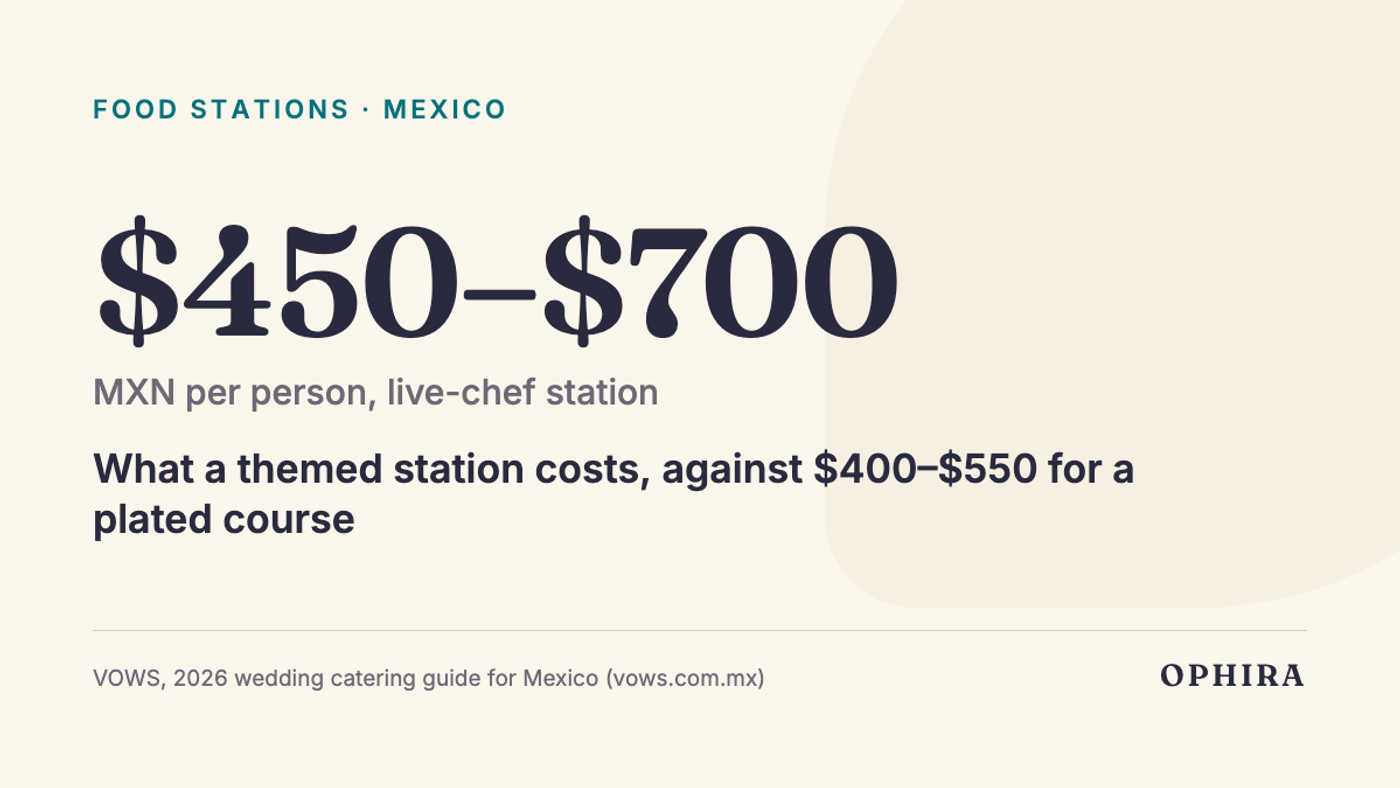
A themed station with live cooking is quoted between $450 MXN and $700 MXN per person in Mexico, according to the 2026 catering guide from VOWS.
In that same guide, a plated dinner of starter, main and dessert — with waitstaff, tableware and basic linen — costs between $400 MXN and $550 MXN per person.
There's the whole post. A station isn't a cheap extra: in pesos per guest it occupies the same ground as the plate it supposedly replaces, or a little more.
And if it replaces nothing, it stacks.
That's the question almost nobody answers when you search for wedding food stations: does this station add to your budget, or substitute for something you're already paying for?
Why searching for wedding stations gives you two internets that never touch
One internet is inspiration: boards, galleries, lists of twenty beautiful ideas with zero pesos.
A good part of that material isn't even Mexican — it talks about vuestra boda, about country estates, about waffles — and arrives at your catering meeting without a single local reference.
The other internet is price, and it quotes the whole reception or the vendor's closed package. In neither did we find the marginal cost of adding a station, nor what that station displaces.
That opacity isn't your fault. The category carries two incompatible units at once — per person and per station — and hardly anyone tells you which one applies to you.
Without that clarification, two quotes aren't comparable even if both say "taco station".
What a station costs: the two clocks in the price
- Per person. The VOWS range this post opens with: $450 to $700 MXN a guest for a themed station with live cooking, against $400 to $550 MXN for the three-course reception. It ties or costs slightly more. It isn't a saving.
- Per station. In Mexico City, Eventech publishes a rate card for live-cooking stations starting at $3,500 MXN.
Here's the part you'd rather not read: that price is for renting the station, and the ingredients are quoted separately.
Eventech states it on that same page, along with the fact that setup and teardown carry no cost within Mexico City.
The number you fall in love with in the email doesn't include the food. When you compare a "from $3,500 MXN" against a "$450 MXN per person", you're comparing a setup against a served plate.
A themed station isn't an extra: per guest it occupies the same ground as the plate it replaces. The decision isn't "do I want it?", it's "what leaves the contract so this can come in?"
The capacity rule decides whether you need one station or four
And the sources disagree. The Wedding Whispers sets the rule of thumb at one station per 40 to 50 guests: with 200 people, a minimum of four different stations to avoid queues.
Eventech, meanwhile, states that each of its stations serves 100 to 250 people.
That distance isn't a nuance. With 200 guests, one rule asks for four stations; the other, between one and two (200 divided by 250, or 200 divided by 100).
Multiplied by a fixed cost per station, the same event changes price by a factor of two to four without anyone having lied to you.
So the question that puts the conversation in order is: how many guests per station did you calculate this with, and how much queueing are you assuming?
What an open bar costs, and what changes if you make it a craft bar
According to VOWS, an open bar of 4 to 5 hours — wines, beers, cocktails and aguas frescas — adds between $150 MXN and $350 MXN per person on top of the reception price.
That's the number any craft bar gets measured against.
Now the craft bar. Roby Peñacastro, of MOBAR, explains on Bodas.com.mx that a cocktail bar with a menu of 4 to 5 drinks, four hours of service and no alcohol, for 100 people, costs between $15,000 MXN and $20,000 MXN.
Divided among those 100 guests, that's $150 to $200 MXN per person for the service alone, still without a bottle inside.
The drinks cart comes out cheaper because it needs no freight service: between $12,000 MXN and $15,000 MXN without alcohol, per the same source. But adding the alcohol can push the cost to $40,000 MXN.
That jump — from $15,000 MXN to $40,000 MXN — is the central warning of the whole drinks category: the quote you fall for almost never includes the bottle.
So, the subtraction: a craft bar at $150 to $200 MXN per guest without alcohol occupies the same range as a full open bar at $150 to $350 MXN with alcohol inside.
If the craft bar comes in as well as the open bar, you didn't change a line: you doubled it.
Coffee stations: the question is whether your catering already includes it
The VOWS reception range specifies what it carries — waitstaff, tableware, basic linen — and coffee doesn't appear on that line.
Before quoting a coffee station, check your catering contract: if the coffee is already inside, you're about to pay twice for the same moment.
If it isn't, a coffee station is quoted with the same mechanics as the live-cooking ones: equipment and setup on one side, ingredients on the other. And the same capacity rule applies.
One barista serving two hundred people at one in the morning isn't a station: it's a queue.
Dessert table: why there's no price here, and what to ask instead
We aren't publishing a dessert-table price because we don't have a verified one for Mexico. We'd rather tell you than invent it.
What we can give you is the logic, which is what changes the total. The VOWS three-course reception already includes dessert.
A dessert table built on top of that reception substitutes for nothing: it's an addition.
It has to enter your budget with its own name and amount, not as "a little something". If you want it to substitute, the negotiation is with your caterer, to take dessert out of the cover before you sign.
Four questions to make any station quote comparable:
- Is the price per person or per station?
- Does it include ingredients, or only equipment, operator and setup?
- How many guests does it assume per station, and how many hours of service?
- What line of my catering stops existing if I book this?
The fourth is the one almost nobody asks. It's the only one that moves the total.
Station ideas that are growing and don't yet have a price in Mexico
The Pinterest Wedding Trends Report 2026 records a strong jump in the sensory cluster:
- flower bar set up +870%
- vegetable centerpieces +380%
- lavender decoration +185%
- perfume bar wedding +140%
- dried orange garland diy +100%
- moss tablescape +90%
- herb wedding +65%
One note that matters: these are Pinterest's internal and global figures. They aren't a measurement of the Mexican market.
And there's the real gap: we found no published price in Mexican pesos for any of those formats. The terms arrive in English or from Spain, with no local figure attached.
If you want a flower bar in Mexico City, you'll be the one discovering the price — and discovering a price costs three quotes and a couple of weeks of back and forth.
The way to stop it stacking is to ask for it as a redesign of a line you already have, not as a new vendor.
A flower bar is asked of whoever is already doing your centerpieces. A craft bar, of whoever is already setting up your bar.
We have no verified figure for how much each swap frees up in Mexico; what does exist is the rule for who to ask: the vendor who already has that line in their contract.
Ideas for entertaining guests without opening a new budget line
The problem a station really solves isn't aesthetic: it's the gaps. The fifteen minutes between ceremony and dinner, the long stretch after the toast.
But dead time gets attacked with several levers, and the cheapest one costs nothing:
- Who you seat next to whom. Deciding how to seat your guests at the wedding tables moves the energy of the whole night at zero budget.
- Capturing the moment, which is already its own line with its own range: check what a wedding content creator costs in Mexico before assuming the station also has to do that job.
Where geography enters the price
The reference everything is measured against: the 2025 sector report from Bodas.com.mx, with more than 2,100 couples surveyed, puts the average wedding at $180,000 MXN for around 140 guests.
That's roughly $1,291 MXN per guest, with everything inside: venue, dress, photography, music, flowers and catering.
Do the math with the VOWS ranges. Catering at $400 to $550 MXN plus an open bar at $150 to $350 MXN gives between $550 MXN and $900 MXN per guest.
That's already between 43% and 70% of those ~$1,291 MXN, and no station has entered yet. Adding $450 to $700 MXN on top doesn't fit without taking something out.
And that $1,291 MXN is a national average: we found no published figure for the average wedding in Mexico City, so treat it as a borrowed reference, not as your city's number.
Geography enters the price through logistics, not glamour.
Eventech clarifies that within Mexico City setup and teardown carry no cost; Bodas.com.mx explains the cart is cheaper precisely because it needs no freight.
The moment your venue leaves the city, freight returns to the quote and the saving evaporates.
When a station isn't your best peso
- If your catering is already signed with a plated menu and the contract won't let you remove courses, the station can only add. Valid, but it comes in as a conscious addition, not an imagined substitution.
- If your list is short. The cost per station is fixed: divided among few guests, the per-head cost spikes. The same figure that looks reasonable with 150 people looks very different with 60.
- If what you want is for the wedding to look different in photos. There are cheaper levers for that. A station is justified when it solves dead time or when it displaces a line. When it only decorates, it's the most expensive way to decorate.
The number you set before asking for the first quote
Three steps, in this order:
- Write your per-guest ceiling for this line before you look at a single photo. With catering and bar taking between $550 MXN and $900 MXN of the ~$1,291 MXN per guest of the national average wedding, what's left for a station is exactly what you decide to take from another line.
- Next to the ceiling, write the line that disappears. If there isn't one, the station is an addition: give it a name and an amount in the budget the same day you consider it.
- Ask for quotes with the four questions and compare them only once all four answers exist.
Once you have the ceiling and the line that disappears, log the station as a budget line with its amount and its vendor in OPHIRA.
You watch it move against the total the day you add it, not the day you've already signed.