What a wedding content creator costs in Mexico, and the four options nobody lists
August 19, 2026 · Equipo OPHIRA
The dilemma you'll meet on almost every page you open is binary: hire a wedding content creator, or go without the content of your wedding.
It's false, and the price itself proves it. Between those two options there are at least four, and each one costs something different.
The question you can answer with numbers isn't yes or no. It's how much scope you're buying: how many hours, how many pieces, and across how many days you want them published.
If the category feels opaque, it isn't because you haven't researched enough. It's structural: it's a few years old and we found no published market measurement in Mexico.
Almost everything ranking on it is written by whoever sells it: vendor profiles, photographer guides, sites where vendors advertise.
So you ask what it costs, and the market answers with a package. A package isn't a price: it's a scope decision somebody else already made for you.
What a wedding content creator is, and what you're actually buying
It's someone filming your wedding on a phone, vertically, thinking about how it will look once published. They hand it back to you edited within hours.
That last part is the product. Creador Wedding specifies in its rate card that "edited content will be uploaded within 48 hours".
The 2026 LatAm guide from VeamosLasFotos puts delivery of the day's content between 24 and 48 hours.
You aren't buying a better camera. You're buying turnaround, volume and vertical format. If those three things don't move you, you already have half your answer.
What it costs in Mexico: the three public references we found
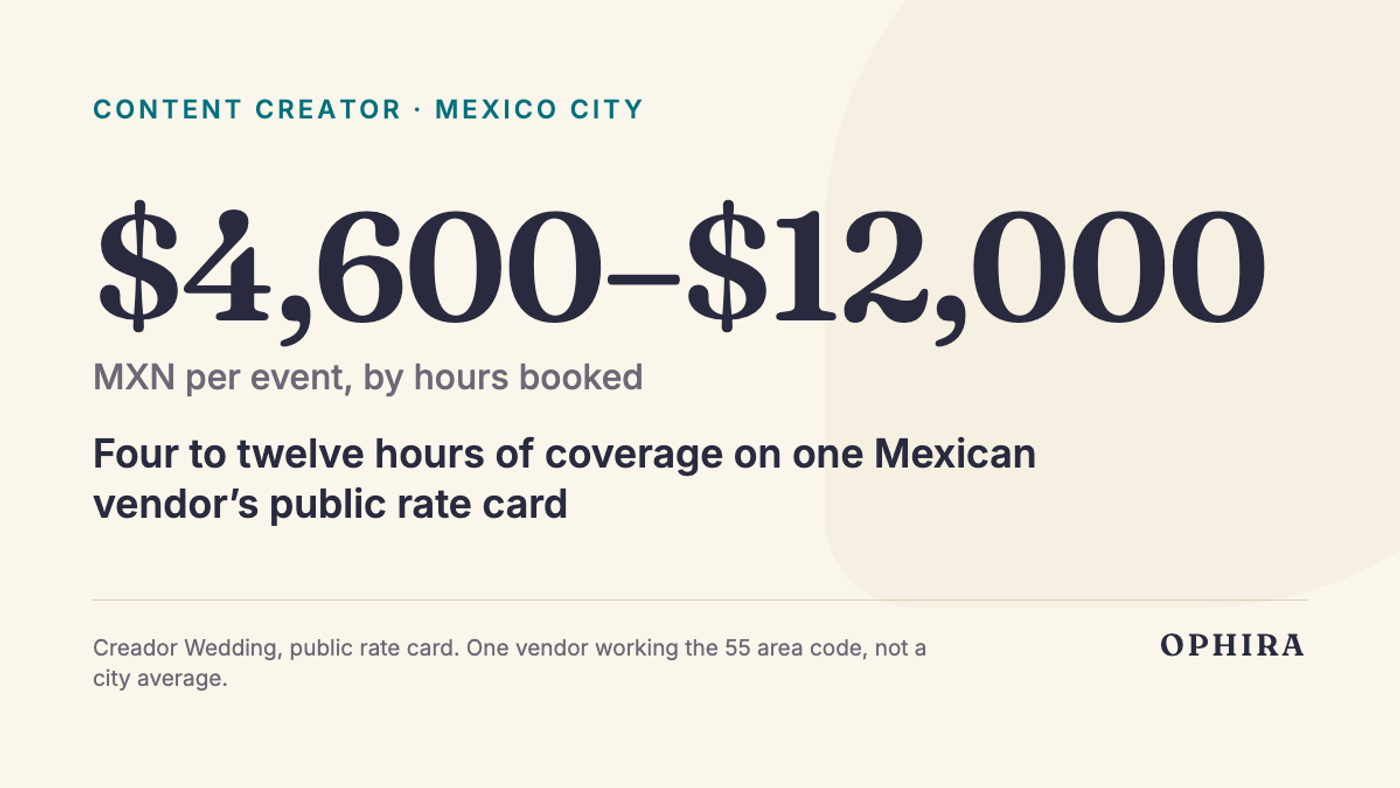
- The full rate card. Creador Wedding, a Mexican vendor answering from a 55 area code — Mexico City — publishes the whole ladder: $4,600 MXN for 4 hours of coverage, $6,500 MXN for 6, $9,000 MXN for 8 and $12,000 MXN for 12. It's as near as we got to a Mexico City price in the open: use it as a reference floor, never as an average.
- The scope tiers. Abre Eventos sorts the same service by coverage: partial (ceremony only or reception only), $4,000 MXN to $8,000 MXN; full with editing and immediate delivery, $10,000 MXN to $20,000 MXN; and bespoke premium production from $25,000 MXN.
- The editorial range. VeamosLasFotos places Mexico between $8,000 MXN and more than $25,000 MXN. It's a guide: it publishes no sample or methodology, so it works as a range reference, not as a measurement of the market.
None of the three publishes a Mexico City market price, and it's worth knowing that before you compare quotes.
Watch the local geography trap too: if your ceremony is in one part of the city and the reception in another, every hour of travel is an hour of coverage you already paid for and in which nothing gets filmed.
In Mexico City, scope isn't measured only in moments. It's measured in traffic.
Why two hourly quotes aren't comparable
Bodas.com.mx estimates the service should be budgeted "between 3,000 and 6,000 pesos per hour of service", and clarifies something important: that hour isn't only being at the event.
- Planning the content beforehand.
- Selecting afterwards.
- An unlimited gallery of photos and videos.
- Post-production of TikToks and reels.
It's a national estimate; the article mentions no city.
Now divide Creador Wedding's large package: $12,000 MXN across 12 hours is $1,000 MXN an hour (the division is ours). Between one reference and the other there's a 3× to 6× difference.
That doesn't prove one is expensive and the other cheap. It proves the word "hour" means different things in each quote.
Comparing by the hour without asking what goes into that hour is the most expensive buying mistake in this category.
Content creator or wedding videographer: what each one does on the day
- The photographer delivers still images that last.
- The videographer delivers an edited piece with camera, sound and rhythm.
- The content creator delivers volume, vertical format and speed.
They aren't substitutes, they're different decisions.
And here we have to be honest: we found no reliable public figure on how many days a videographer in Mexico takes to deliver. You won't find an invented one in this piece.
What you can do is turn the gap into a question, before signing: in how many calendar days do you deliver the first vertical piece, how many pieces are there, and at what cost?
If you want to see how that whole conversation is built, what to ask a wedding vendor before signing has the script.
Does your photographer already include reels and social content?
The honest answer is that we found no public data saying what share of Mexican photographers includes it. If someone gives you that percentage, ask for the source before believing it.
What's verifiable is something else: the three roles are quoted separately, and an entire rate card exists — 4, 6, 8 and 12 hours — dedicated only to this.
That the category sells itself suggests it isn't included by default; it doesn't prove it.
So don't assume it and don't rule it out. Ask for it in writing, with three specifics:
- How many vertical pieces.
- In how many calendar days.
- Whether those pieces come from footage already being shot, or require somebody filming on a phone in parallel.
That third question is the one that changes the price.
Who films the TikToks: four options and what each one costs
- You. $0 MXN. The cost isn't money, it's attention: every moment you film is a moment you're watching through a screen.
- Someone you trust, with a clear brief. $0 MXN. A sister, a friend, a cousin. They need a list of three to five moments and to know what matters to you; they don't need talent. It's the option that almost never appears in writing: whoever writes about the topic tends to be whoever provides the service. That isn't bad faith, it's everyone talking about their own trade.
- Your photographer or videographer, negotiated before signing. It can cost nothing if it was already in the package, or whatever they quote if it wasn't. What's expensive is assuming.
- A dedicated content creator. $4,600 MXN to $12,000 MXN depending on hours (Creador Wedding), or $4,000 MXN to $8,000 MXN for partial coverage and $10,000 MXN to $20,000 MXN for full coverage with immediate delivery (Abre Eventos).
The audit: six questions to run against your own plan
- How many moments do you want vertically, written down? If listing them gives you three or four — getting ready, the entrance, the first dance — your scope is 4 hours, not 12. Booking 12 "just in case" is paying $12,000 MXN for coverage nobody asked for.
- When do you want it published? If the answer is "that night or the next day", you're buying turnaround, and turnaround is the line being quoted. If you can wait, maybe you don't need a new budget line.
- How many venues, and how much travel? In Mexico City this question costs money. Add the travel to the contracted hours before choosing the package, not after.
- What does your photo and video contract literally say about "vertical" and about "delivery time"? If it doesn't say it, it doesn't include it.
- Are you buying hours or files? Creador Wedding's 4-hour package delivers 1 recap video of 40 to 60 seconds, 3 trend videos, 10 edited photos and between 100 and 200 files. The 12-hour one delivers 3 recaps, 8 trend videos, 30 edited photos and between 400 and 500 files. More hours isn't more of the same: it's a volume somebody will have to review.
- Who reviews and approves before publishing? If the answer is "nobody, we'll see", the deliverable becomes a to-do for the week after your wedding.
The first thing to fix is question 4. If you do only one thing with this piece this week, open the photo and video contract and look for those two words.
Almost every other decision depends on what you find there.
What a yes looks like, and what a no looks like
The only adoption figure with a declared sample that we found isn't from Mexico.
Zola's 2026 Wedding Spend Survey, taken among more than 700 couples married in the previous six months in the United States, found that 1 in 5 couples (21%) hires a niche vendor. Of those hires, the wedding content creator accounts for 22%, and more than 60% spend between 500 and 999 dollars.
It's a different market from Mexico's: it works as a signal of where the category is heading, not as a price reference for your wedding. We found no equivalent figure published for Mexico.
It looks like a yes when you already have the list of moments, you want them published within 48 hours, and the amount fits without displacing another line.
It looks like a no when the list doesn't exist yet, or when the yes means taking from something else.
The uncomfortable part, which no rate card writes down: hiring one well means accepting that somebody will be near you, with a phone, for a good part of the day. And that 400 to 500 files don't review themselves.
The cost of this line doesn't end when you pay.
When this line isn't for you
- Ignore it entirely if you aren't going to publish.
- Ignore it if your budget is already closed and this line would only enter by taking from one that matters to you.
- Ignore it if the mere idea of somebody filming you up close tires you as you read it: that reaction is data too, and it's enough.
The content of your wedding isn't your wedding. It's the summary other people will see of it.
Whether it exists at all, and at what size, is your decision. It's made better calmly than at eleven at night, three weeks out.
If you decide yes, what makes this line manageable is treating it like any other: a range, a delivery time and an owner, written down before signing.
You can log the line with its range and its delivery date in OPHIRA and see how the rest of your budget settles before deciding.