Your wedding day timeline: the hours you already bought without noticing
August 19, 2026 · Equipo OPHIRA
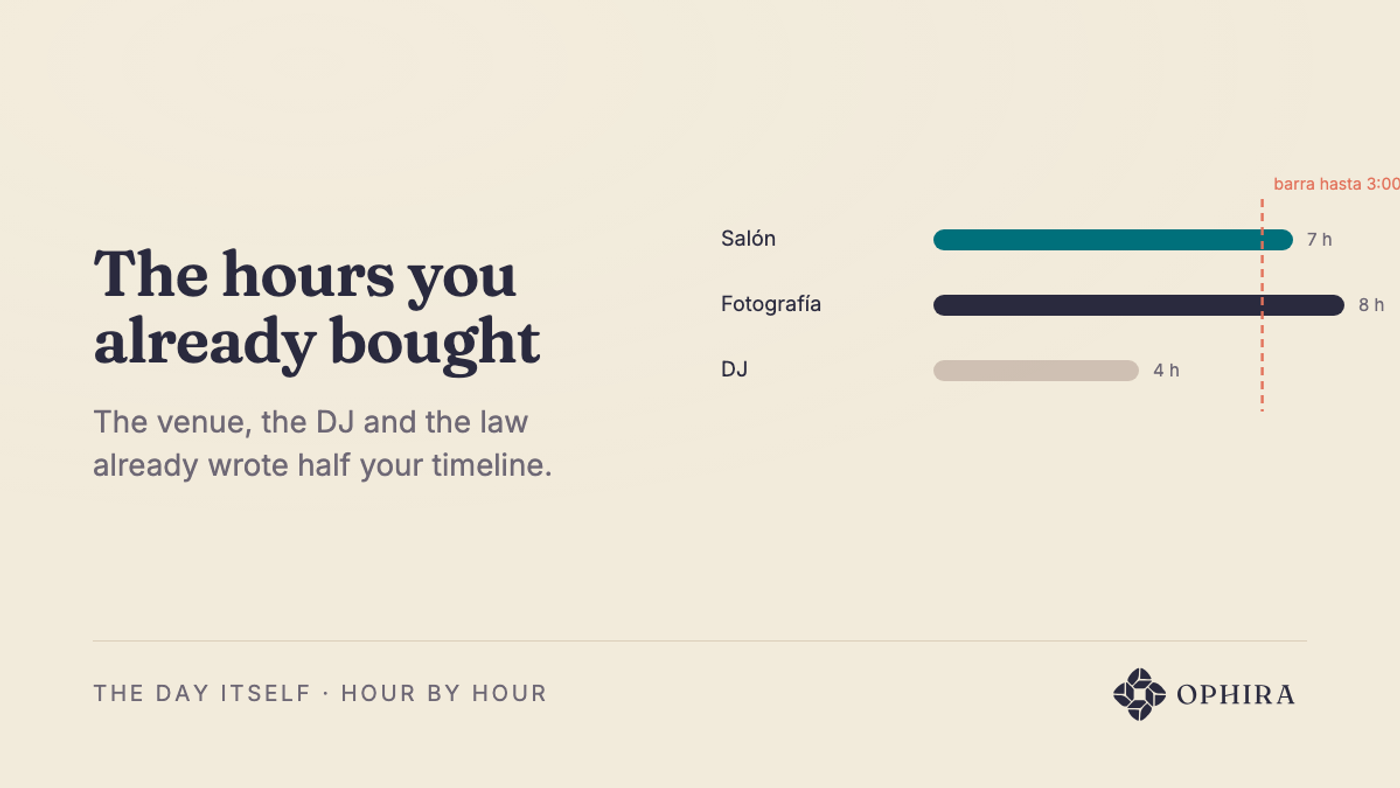
Your wedding lasts fewer hours than you think, and the number is already signed.
When a couple sits down to build the timeline for the day, they almost always start with what they want to happen: the entrance, the first dance, the toast, the late-night set. It's the natural order to think in, and it's the one that produces timelines that don't fit.
Because by the time you open that spreadsheet, three contracts have already written half the day. The venue sold you a number of hours. The DJ comes with a different one. And on top of both sits a cutoff nobody negotiates, because it's the law.
What time the bar closes at a Mexico City venue
Let's start with the one that doesn't depend on your budget.
The Mexico City Commercial Establishments Act, in article 24, classifies event halls as a neighborhood-impact business. Their service hours are unrestricted, but the sale, consumption or distribution of alcohol is limited to a specific window: from 10:00 until 3:00 the following day.
That's the hour your party changes character, no matter how late you contracted it. It isn't venue policy and it isn't the manager's suggestion.
And it has a practical consequence almost nobody works out: if your reception starts at 21:00, you don't have "all night". You have six hours of bar, and everything else works backwards from there.
How many venue hours you're actually buying
The second ceiling comes in the venue contract, and it comes with fine print worth reading twice.
The Gran Hotel Ciudad de México publishes its wedding packages by venue hours — 5, 6 and 7 depending on the package — and each one specifies the same thing: the contracted time includes 30 minutes of arrival and 30 minutes of load-out.
That last line is the one that surprises people. Load-out is exit time, and it's inside the clock: it isn't 30 minutes the venue gives you at the end, it's 30 minutes your party no longer uses.
A 5-hour package, then, isn't five hours of party. It's five hours of service with half an hour of arrival in front and half an hour of exit behind.
What each of those packages costs lives in our breakdown of venue rental prices in the capital. Here only the clock matters.
A photography package is a timeline disguised as a price
The third ceiling is the most revealing, because the vendor already did the arithmetic for you and published it.
Celebra Studio, a Mexico City wedding photographer, doesn't sell "hours": it sells named blocks.
Its 5 continuous hours split into 1 hour of Mass and 4 of party, for $6,000 MXN. The 6-hour package adds 1 of Mass, 1 of photo session and 4 of reception, for $8,000 MXN.
And the 8-hour one opens into 1 of getting ready, 1 of photo session, 1 of Mass and 5 of reception, for $10,000 MXN.
Read it for what it is: somebody who has photographed a lot of weddings is telling you how long each block of your day really takes.
One hour getting ready. One of ceremony. One of session. Five of reception. If your timeline gives the photo session 40 minutes because that's all that fit, you're not being optimistic: you're contradicting the person who charges for measuring it.
And if yours is the 5-hour package, the arithmetic is brutal in its clarity: there is no getting-ready hour and no session. It starts at the Mass.
What it costs to stretch the day by one hour
This is where the timeline stops being a spreadsheet and turns into money.
Echoe Entertainment, a Mexico City DJ vendor, quotes with 4 hours as its base and publishes the full ladder: the Esencial package costs $5,000 MXN for 4 hours and rises to $9,000 MXN for 8, with an extra hour at $1,000 MXN. The Plata package charges $2,000 MXN per extra hour. All of them plus IVA, which is Mexican VAT.
Four base hours against a venue of five, six or seven. The clocks don't line up, and that gap gets paid at dawn on your wedding, when nobody is negotiating any more.
The arithmetic worth doing beforehand: if your venue is 6 hours and your DJ is 4, you're two short. At $1,000 MXN an hour on the cheapest package that's $2,000 MXN plus IVA — and that's if you decide it calmly, not at two in the morning.
How to build the timeline backwards
With the three ceilings on the table, the sequence stops being creative and turns into arithmetic:
- Fix the real closing time. It's the earlier of the end of your venue package and the 3:00 the law sets.
- Subtract load-out. Half an hour in the Gran Hotel example; yours will state its own.
- Subtract the reception hours you bought. That gives you the hour the party starts — not the one you'd like.
- Put the ceremony one hour earlier, which is how long it runs according to the blocks photographers publish.
- Place the session and getting ready only if your photography package includes them. If it doesn't, they don't exist in your day.
- Compare the DJ's clock against the venue's and decide today who covers the gap.
What comes out of that arithmetic isn't the day you dreamed. It's the day you bought, which is the only one that's going to happen.
If you don't like the result, there's still time to change the contract — which is exactly the point of doing this arithmetic now and not the week of the wedding.
And once the hours are fixed, seating becomes the next piece: how to seat guests at your wedding tables closes with the RSVPs, not with the timeline.
When you don't need this arithmetic
If your wedding is under 40 people somewhere that doesn't close by contract — a house, your own garden, a long lunch — this calculation is surplus to you.
The three ceilings above exist because there's a contract in the middle. With no venue contract, no package of hours and no bar subject to a license, the day stretches on its own.
There the timeline is a courtesy to your guests, not a constraint.
It's also surplus if you contracted a stations format instead of a plated dinner: there the food runs the clock rather than the sequence, and what wedding food stations cost breaks that down.
The three lines worth writing today
Open your three contracts — venue, photography, music — and write on a single line how many hours each one carries. Nothing else.
In most cases the three numbers don't match, and seeing the gap written down is what turns a 2 a.m. surprise into a decision you make today.
If you want that line living next to your budget and your guest list instead of in a loose note, you can open your space in OPHIRA and leave the hours of each contract there. It's free for the couple and asks for no card.