"Is it rude to ask for the contract?" What to ask a wedding vendor before you sign
August 19, 2026 · Equipo OPHIRA
"Would it be rude to ask you to put that in writing?"
Almost nobody sends that message. It gets typed, deleted, and swapped for "perfect, let's do that!"
Underneath sits a second, quieter question: what if they take offense and I end up awkward with the person who'll be there on the day?
The awkwardness is real, but it isn't yours. It belongs to the category.
Hiring vendors for a wedding is one of the few large purchases in life where the price is agreed over WhatsApp and the scope lives in an unsigned PDF.
The instruction "get a contract" is repeated everywhere, without anyone saying what that contract should contain. The rule arrives inherited and incomplete. Which is why asking for clarity feels like distrust, when it's the opposite.
This piece isn't about who to choose. It's about the exact minute of signing with each vendor: what you ask, what you insist on in writing, and what each answer means.
What a wedding vendor contract should include: Profeco already wrote the model
Profeco keeps a public file of standard-form contracts — the Registro Público de Contratos de Adhesión — with a registered model for exactly this trade: "Provision of Social Event Services". You can read it in full before your first appointment, free, from your phone.
No vendor is obliged to use it. That's the uncomfortable part. But it's the public standard against which you measure whatever paper they put in front of you.
Three things that model puts in writing and that almost no quote mentions:
- Who answers if a subcontractor fails. Per Profeco's model contract for the provision of social event services, clause TENTH, the vendor you signed with answers to you for the breach even if they subcontracted the service to third parties. "The audio guy let me down" doesn't release them.
- What you're owed if the vendor defaults. The same model, clause NINTH: if they default for reasons attributable to them, you choose between two outcomes. Either they hire another company at their own expense and absorb the additional cost, or they return everything you paid plus a contractual penalty of 20% of the total price.
- That a clause worse than the model doesn't count. Any variation to the consumer's detriment against the registered standard-form contract "shall be deemed not to have been written" (Profeco, registration note).
The part that stings: asking for all of this has a cost. Vendors who document liability, contingency plans and penalties tend to quote above whoever sends you a price and a date in a message.
You're paying for the backing, and backing gets charged for. If your only criterion is the lowest number, this piece will cost you money.
How much deposit is paid to hold a venue
We found no Mexican regulation setting the deposit percentage.
Any figure presented to you as "the market standard" is custom, not law. Treat it as custom: negotiable and documentable.
What is written down are two things:
- That same Profeco model contemplates, in clause FOURTH, a security deposit equal to 10% of the stipulated price to cover excess services, contingencies or damages. If none of those situations occurred by the end of the event, the vendor must return it to you. It's a deposit, not a payment.
- For the deposit, the vendor is obliged to issue you a receipt with eight minimum fields, starting with their name or business name and the date and amount of the deposit.
If what you received was a photo of a receipt that doesn't even carry that, you don't have a receipt: you have a confirmation.
You can cancel a signed wedding contract: you have five working days
This is the line we couldn't find in the blogs ranking for this search.
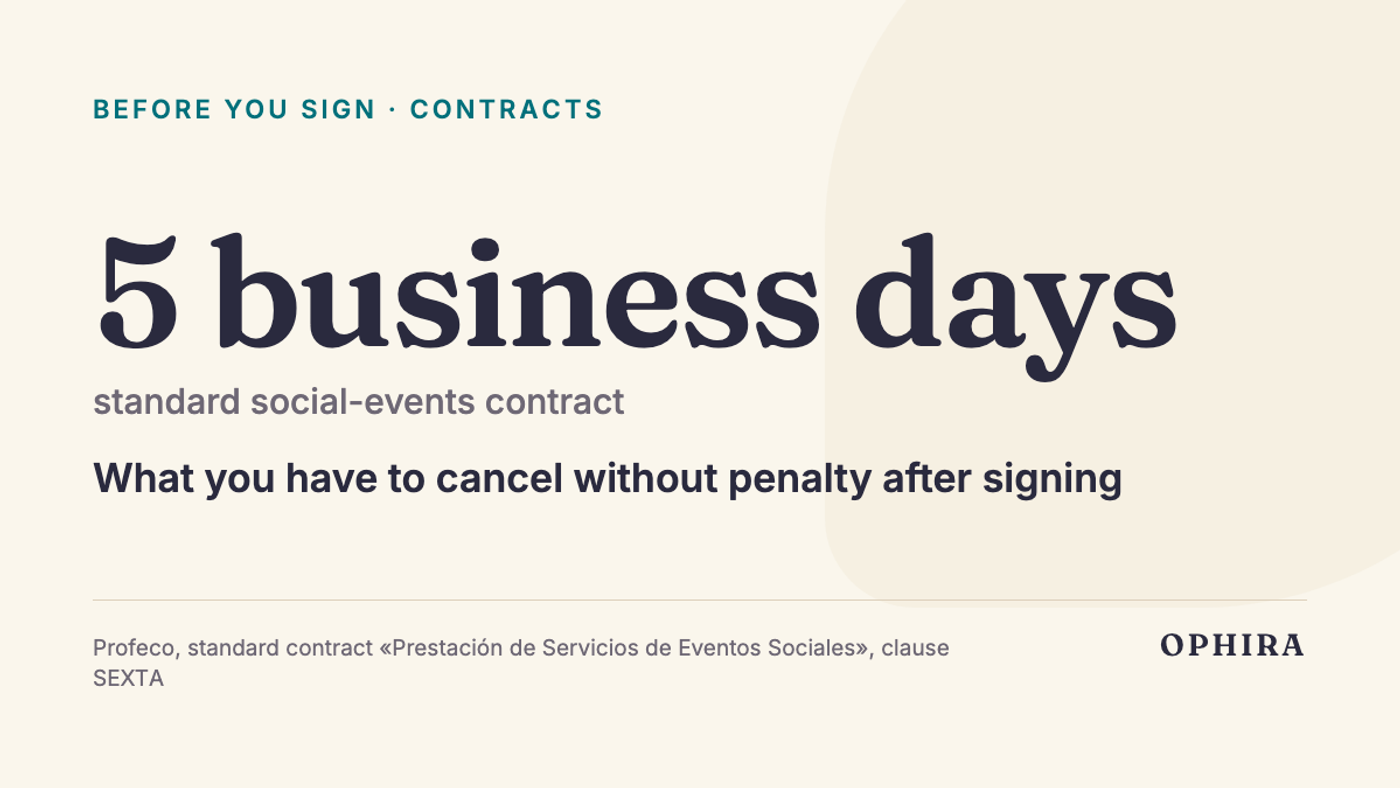
Profeco's model contract, clause SIXTH, gives you five working days after signing to cancel with no liability whatsoever on your part. And it obliges the vendor to return everything you handed over.
If you cancel after that window, what you owe isn't the full deposit or 100% of the package: it's capped at demonstrable expenses of up to 20% of the total price. Demonstrable means they prove the expense, not that they assert it.
Two honest warnings:
- The five days are working days and start running at signature. The window is short: it's decided beforehand, not afterwards.
- This lives in the registered contract. If your vendor uses their own boilerplate, the clause may simply not be there.
Since the clock runs from signature and not from payment, that date is worth keeping where you can see it, not inside a saved PDF. Four column headings put it in plain view on the sheet you already use:
- Committed — the total of the signed contract.
- Paid — what has actually left your account.
- Outstanding — committed minus paid. The column you read without adding anything up.
- Date signed — the day you signed.
The fourth looks like the least useful and is the one that can cost you money: it's the only one that tells you whether you're still inside the five days.
Asking beforehand costs one message; finding out afterwards costs the deposit.
How many quotes to get per vendor, and why two are rarely comparable
There's no magic number, and anyone who gives you one is inventing it. The useful question isn't how many quotes you get, but how many are comparable.
Two quotes only compare when they say the same thing in three fields:
- Hours of coverage.
- Deliverables.
- VAT.
The third is what blows up entire budgets. The Value Added Tax Law, in article 1, sets the rate at 16% and establishes that the tax is in no case considered part of the quoted value.
It also obliges the vendor to pass it on to you "expressly and separately". Meaning: you have the right to a quote that states in plain words whether the price already includes it.
On a package of $200,000 MXN, that 16% is $32,000 MXN on top ($200,000 MXN × 0.16). Exactly the difference between two "almost identical" proposals.
Operating rule: get as many quotes as you need until you have at least two you can put side by side with the same scope. One alone gives you no range. Many without matched scope give you only noise.
How to choose wedding vendors when every portfolio looks good
Portfolios look alike because they're curated. What doesn't look alike is the scope.
To calibrate the conversation — not to disqualify anyone — public references help. Cronoshare México publishes its ranges from the quotes professionals send through its platform.
There, a professional wedding photographer in Mexico City sits between $10,000 MXN and $45,000 MXN. The source itself clarifies that the figure varies with hours contracted, guest count and type of service.
Which is why "how many hours of coverage does it include?" moves the price more than almost any other question.
In the same source, DJs in Mexico City tend to charge between $5,000 MXN and $13,000 MXN, and a wedding planner's service in Mexico City sits at roughly $26,000 MXN to $75,000 MXN.
That last figure carries a question almost nobody asks. Day-of coordination alone, without full planning, runs between $8,000 MXN and $12,000 MXN. That's a national range in that same source, not specific to Mexico City.
Many planners sell that scope separately and won't offer it unless you ask.
You won't find recommended names here. If a quote falls outside the range, the question isn't "is this expensive?", it's "what different scope am I reading?"
Red flags: signs that information is missing
Almost none of these signals is bad intent. They're signs of a trade working with inherited formats, where documenting was never part of the job.
Read them as missing information, not as character.
- The quote doesn't say whether the price already includes VAT. The law requires it to be passed on expressly and separately; its absence is an old format, not a trap. Ask for it in writing.
- The deposit receipt doesn't carry even the minimum fields: name or business name of whoever received it, date, and amount.
- The contract only describes your obligations and says nothing about what happens if the vendor doesn't show. It's incomplete, not against you.
- "We'll sort that out later" about extra hours, travel expenses or delivery times.
- They refuse to put in writing something they already told you out loud. Take this one seriously. Not for what it says about the person, but because it leaves you with no way to resolve anything if something shifts.
The script: what they'll answer, and what it means
You: Before the deposit, could you send me the full contract so I can read it properly?
Vendor: Of course, I'll send the template. Hardly anyone asks.
Good sign. Read it looking for three things:
- Scope with numbers: hours, pieces, people.
- What happens if they don't show.
- How long it takes to get the security deposit back.
Vendor: The deposit is non-refundable, it's house policy.
You: Understood, that makes sense. Can we put that in the contract, along with what happens on the other side if you can't cover the date?
You're not fighting the deposit. You're asking for symmetry.
A contract with only one side's obligations written down is a half contract, and noticing that doesn't make you difficult.
Vendor: We've never had a problem, don't worry.
You: I believe you, and that's exactly why I'm asking: so I don't have to worry.
The other conversation: with whoever recommended them
Your mother: I already know him, he did your cousin's wedding. Don't go making him feel bad asking for paperwork.
You: It isn't distrust. It's that if something shifts, I want us both to know what happens next without having to argue about it that day.
Your family's recommendation is valuable information: somebody has already watched them work, and no portfolio replaces that. What it isn't, is a contract.
Both things fit in the same relationship. Saying so out loud usually lowers the tension faster than avoiding it.
When you need none of this
If your aunt is making the cake as a gift, or you're paying a small amount with no deposit and no date held, building an adhesion contract is over-engineering. A message with scope and date is plenty.
If you signed months ago, this piece doesn't rescue that contract. It's for the ones still ahead.
And if a full-scope planner signs on your behalf, the conversation moves to their contract: there, what you check is who they represent and who answers to you.
If this, then sign
If the contract says these three things:
- Exactly what's included and how many hours it covers.
- Whether the price already carries the 16% VAT or it's added on top.
- What happens if the vendor can't cover the date.
Then you sign and move on without looking back.
If any of the three is missing, then you don't argue and you don't apologize: you send the message and wait for the answer in writing.
Whoever answers in writing has already told you half of what you needed to know.
The message to send today:
Hi [name]. Before I make the deposit I'd like three things in writing: exactly what the package includes and how many hours it covers, whether the price already includes VAT or the 16% is added, and what happens if for any reason you can't cover the date. Could you send that in the contract? With that I'll make the deposit.