What's worth spending on at a wedding: the layer the percentage pie never prices
August 19, 2026 · Equipo OPHIRA
The rule says the venue and the catering take the biggest slice of the budget. Decor and music have theirs, and so on until it adds up to a hundred.
That percentage pie shows up in almost every wedding planning guide in Mexico. It works well for what it was built to do: divide a total so it doesn't overflow.
The problem is that the question changes halfway through. Once you've set the total and decided you're not going to move it, you stop dividing and start concentrating.
That's where the pie goes quiet, because it distributes but it doesn't rank.
And there's something else the pie leaves out, precisely what matters once the total is closed: the production layer. The light, the dance floor, the live music, the dessert table.
All of it lives hidden inside "decor" or inside "other", with no line of its own and no published price.
That isn't an oversight on your part. That information almost never appears in budget guides: it lives on the pages of the vendors who rent each piece, one by one, each with their own vocabulary.
Which is why the first lighting quote you receive is usually also the first figure you have ever seen in that category. A figure with nothing to compare it to isn't evaluated: it's accepted or dismissed.
Why the percentage pie doesn't answer "what's worth spending on"
A percentage tells you how much fits, not what gets noticed. In the production layer, the difference between spending well and overspending isn't about amount: it's about concentration.
Two weddings with the same budget and the same guest count can feel completely different. It depends on which two or three things got the money from this layer.
Be careful, too, with the figures that arrive in English, because those are the ones that travel furthest.
According to The Knot 2026 Real Weddings Study, which surveyed 10,474 couples in the United States married in 2025, the average wedding there costs 34,200 dollars, at 292 dollars per guest.
That's a US figure, not a Mexican or global one. Use it to understand that the order of magnitude in that market is different — never to plan yours.
The Mexican signal is another thing entirely. BodasMexico.com.mx puts catering in Mexico City between $677 MXN and $753 MXN per guest.
It also describes the capital's market as broad and competitive, with options from simple to premium. That's the floor you'll compare everything else against.
What wedding lighting costs in Mexico City
It's the line that most changes how a wedding is perceived and the one that least often comes with a price.
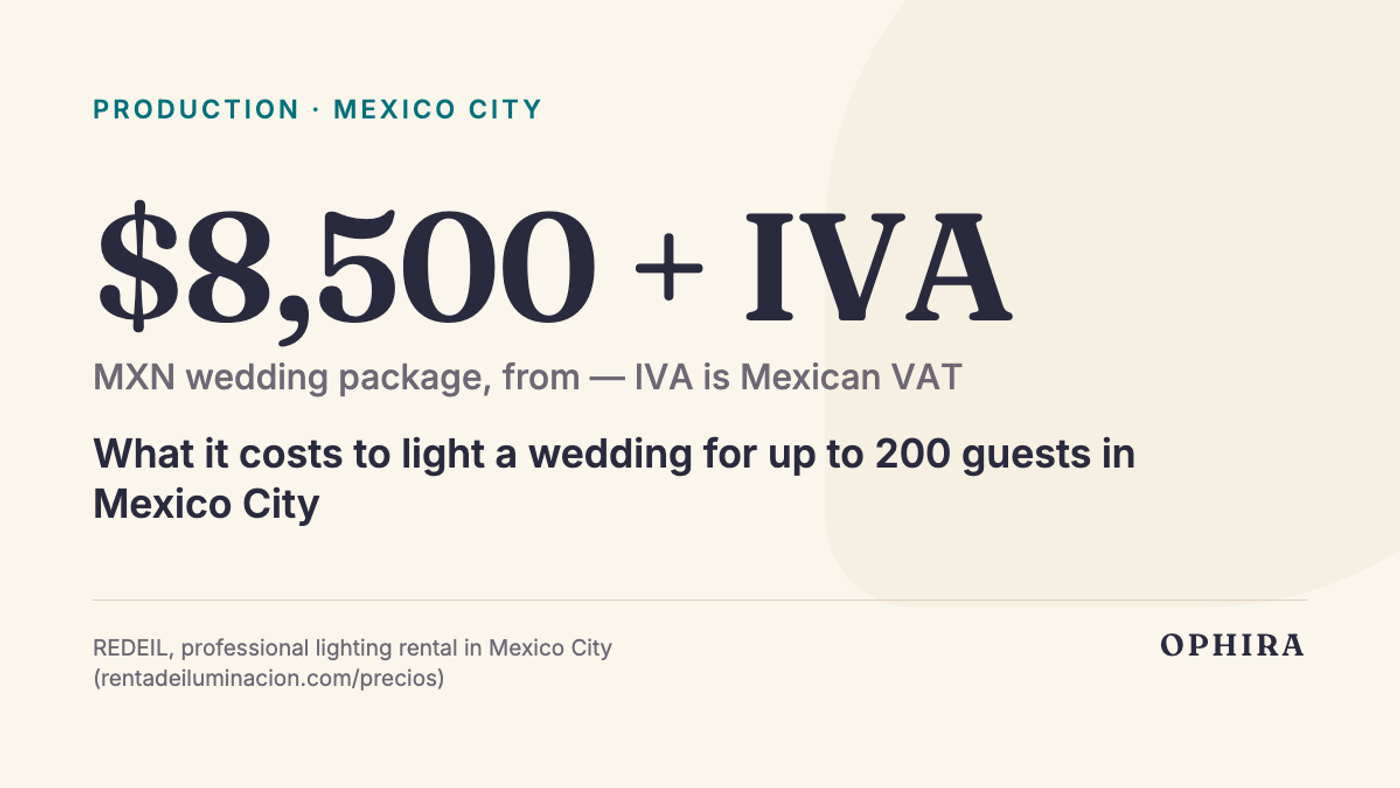
REDEIL, which rents professional lighting in Mexico City, publishes its wedding package from $8,500 MXN plus VAT. It includes string lights, uplighting and a low-fog effect for the first dance, for up to 200 guests.
The same page gives both ends of the scale:
- Basic garden string-light package: from $3,500 MXN plus VAT.
- Full production with lighting, audio and effects for a wedding: from $15,000 MXN plus VAT.
Two details that change how quotes compare:
- Lead time. The same source recommends booking 2 to 4 weeks ahead, and 6 to 8 weeks in high season — November to January and May to June — because weekends sell out.
- Transport. REDEIL states that transport is included for the whole Valley of Mexico metropolitan area.
"Transport is included in the price of the service for the entire ZMVM — there is no additional charge for travel within the metropolitan area."
And an awkward point worth saying out loud: $8,500 MXN plus VAT is not $8,500 MXN.
When you compare two quotes, make sure both are with tax or both without. It's the most common mistake and the most expensive.
Renting an LED dance floor: why you won't read a range here
We looked for a verifiable price for an LED dance floor in Mexico City and found no source that publishes one and stands behind it. So we're not going to give you a range.
The figures circulating in blogs for this line didn't survive verification. And an invented number with two decimals is worse than no number: it hands you a false reference to negotiate against.
What we can give you is how that quote gets built, so you ask for it in full:
- Exact measurement in meters, not "small or large floor". The price moves by square meter.
- What the number includes: transport, setup, teardown, and who stays to operate it during the event.
- Where the venue is. Solo Vivelo warns that if the wedding is outside the city, some vendors charge travel expenses of $1,000 MXN to $5,000 MXN per vendor, a cost that almost never appears on the initial quote. With four out-of-town vendors, that's an entire budget line.
- What it overlaps with. An LED floor and an uplighting package compete for the same visual effect. If you hire both without discussing it, you're paying twice for the same feeling.
DJ or live band: what changes downstream
Here there is a price signal. According to the Solo Vivelo cost guide, a professional wedding DJ in Mexico City charges between $8,000 MXN and $25,000 MXN per event, with equipment included, a custom playlist and specific wedding experience.
For a live band there's no public figure we can stand behind, and that isn't an accident. They're quoted by show hours, number of members and technical requirements: the same band has three different prices depending on the night.
What you can control is the comparison. These are the three routes and their downstream effect:
- DJ with equipment included. Music and audio land in a single line and a single setup. It's the route with the least coordination.
- Live band. Ask in writing whether the price includes audio, how many sets they play, how long each break lasts, how many hours they need for setup, and whether they need a stage or extra power. If audio isn't included, you're no longer comparing against the DJ: you're comparing against the DJ plus an audio rental. That's where the full production package at $15,000 MXN plus VAT comes in.
- Both. Band for the first hour, DJ for the rest. That's two contracts, two setups and a live changeover somebody has to coordinate while you're off taking photos.
None of the three is the right one. The right one is the one you can compare with the same ruler.
What a dessert table costs in Mexico City (search for it as mesa de dulces, not mesa de postres)
First, the vocabulary, because it's costing you search results. Mexican vendors sell it as a mesa de dulces or a candy bar, almost never as a mesa de postres.
Search with the wrong words and you find half the market.
In Mexico City, MEDEDUL publishes four tiers:
- Essential: $4,500 MXN.
- Signature: $7,900 MXN.
- Atelier for weddings: $12,500 MXN.
- Bespoke: upward from there.
It's the easiest line in this layer to calibrate, because its effect is bounded to one moment and one corner of the room. That makes it a good candidate for the basic tier when you've decided to concentrate elsewhere.
What wedding production costs in Mexico: the sum nobody publishes
Put together the three price signals in this post — two Mexico City vendors and one cost guide, not a market average — and the production layer looks like this:
- Contained version: lighting $8,500 MXN + DJ $8,000 MXN + dessert table $4,500 MXN = $21,000 MXN, before VAT where it applies.
- High version: full production $15,000 MXN + DJ $25,000 MXN + Atelier $12,500 MXN = $52,500 MXN, before VAT where it applies.
That's a number we didn't find published in any of the guides we reviewed. Which is why you arrive at the table with no reference.
Solo Vivelo puts the mid-range wedding in Mexico between $100,000 MXN and $300,000 MXN for 80 to 120 guests, with:
- Vendors with a proven portfolio.
- Three-course catering with full service.
- Professional photography.
- A DJ with equipment.
- Decor with fresh flowers.
Against that frame, the production layer isn't an extra: it's a real sizing decision.
Now the uncomfortable part. Using the BodasMexico catering signal, those $21,000 MXN of the contained version equal dinner for between 28 and 31 guests in Mexico City ($21,000 ÷ $753 MXN = 28; $21,000 ÷ $677 MXN = 31).
Light doesn't feed anyone. If you're going to fund this layer by trimming the catering, do it with your eyes open and the number in front of you: the breakdown is in what wedding catering costs per person in Mexico City.
And leave the cushion: BodasMexico recommends setting aside at least 8% to 12% of the budget for the unexpected.
What to spend on and what to save on when the total no longer moves
This post isn't about spending less. Here the total is already set and only gets redistributed.
Three questions put the whole layer in order, and you answer them, not us:
- How much of the night is it switched on? The lighting works for six hours. The dessert table works for twenty minutes. At the same price, they don't return the same.
- Does everyone see it, or only whoever walks past? What frames the whole room reaches all 200. What lives in one corner reaches whoever walks over to it.
- Does the venue already include it? Many venues hand over basic lighting and ambient audio as part of the rental. If yours does, hiring the full layer is paying twice for the same thing. Get it in writing before you quote anything.
Whatever falls to the bottom of that list is where you save, without guilt and without explanation. Not because it doesn't matter: because you already decided where it does.
When to ignore all of this
If your wedding is lunch for forty people in a garden at midday, ignore this post entirely. The light is the sun and the music fits in one good speaker.
The production layer has no work to do. Concentrating there would be buying a solution to a problem you don't have.
Ignore it too if:
- You haven't closed the total yet: the big number first, then the concentration.
- Your venue contract already includes lighting and audio.
- The two of you simply care about something else.
There are weddings remembered for the food and nothing else, and that's a complete decision too.
And if you are going to concentrate, all you need is to see the effect before you sign: how much of the total is left once this layer arrives with a name of its own, instead of hidden in "other".
You can build your budget in OPHIRA and give production its own category, with its amount and its deposit date. That way you decide with the number in front of you, not with the first quote that happened to arrive.