A sustainable wedding in Mexico: what it costs, and why the saving isn't where you're told
August 19, 2026 · Equipo OPHIRA
There's an argument that comes up in every planning session: does a sustainable wedding come out cheaper or more expensive?
One side swears local flowers and rented furniture bring the cost down. The other swears anything labeled "eco" carries a markup.
Both are answering the same question badly. "Sustainable" isn't a budget line: it's an adjective that can land on any of them.
And in a budget, the only thing that decides whether a change is felt or not is how much the line it landed on weighs.
That calculation — the percentage turned into pesos, against the real weight of each row — is exactly what we couldn't find in what gets published on the topic in Mexico.
Of the guides we reviewed, the ones with peso figures don't touch sustainability. The ones that talk about sustainability don't carry a single figure in pesos.
It isn't that you lack discipline: you lack the arithmetic. Here it is, with Mexican sources.
What a sustainable wedding costs in Mexico: first, the total you're measuring against
There's no such thing as a "sustainable wedding price". There's the price of your wedding, and inside it, three or four rows a sustainable decision can move.
The national anchor is solid and comes from two different directions:
- Cronoshare México, in its wedding pricing guide, calculates average spend on a wedding for around 100 guests at about $180,000 MXN.
- bodas.com.mx, surveying more than 2,100 couples for its 2025 look at the sector, reaches the same $180,000 MXN — but for weddings of around 140 guests.
Two methodologies, one number. The bodas.com.mx report translates its own into an average of $1,291 MXN per guest; Cronoshare's, divided by its 100 guests ($180,000 MXN ÷ 100), comes out at $1,800 MXN.
That's your denominator. If you're marrying in Mexico City, it's reasonable to expect to run above that national average, so the calculation that follows is conservative for you.
Is a sustainable wedding cheaper? Only when you remove, not when you substitute
Here's the rule that puts the whole topic in order, and it's three verbs:
- Substituting a material for its responsible version — certified recycled paper, plant-based inks, organic textiles — almost never lowers the price. That process is quoted as added value, not as a discount. You pay for it, and paying for it is fine: just don't count it as a saving.
- Removing consumption does save. If you don't print, you don't pay for printing. It's the only way a sustainable change turns into pesos directly.
- Reducing scope — fewer pieces, fewer venues, fewer guests — is the only verb that moves large amounts, and it's also the only one that costs something other than money.
The market's confusion comes from putting all three in the same sentence. A "sustainable" proposal can be any of them, and no quote clarifies which because the vocabulary doesn't exist yet.
Nobody is acting in bad faith: it's a young category describing itself with a single word.
What you save with digital wedding invitations in Mexico: the full calculation
It's the most-cited change and the easiest to calculate. According to the invitation guide from Cronoshare, a printed wedding invitation costs between $10 and $50 MXN per piece nationally.
In Mexico City, an invitation using one of the designs the vendor already has, with printing and envelope included, starts from $20 MXN.
A hundred printed pieces is therefore between $1,000 MXN and $5,000 MXN (100 × $10 MXN and 100 × $50 MXN). In Mexico City, $2,000 MXN as a floor (100 × $20 MXN).
That's the maximum saving from going digital: up to $5,000 MXN, or 2.8% of a $180,000 MXN wedding ($5,000 MXN ÷ $180,000 MXN).
It's real, it's clean and it's worth it for the logistics: the RSVP arrives on its own and stops being a task.
But if someone sells you digital stationery as the decision that's going to rescue your budget, the arithmetic doesn't hold it up.
What wedding flowers cost in Mexico, and why two quotes never look alike
This is the row where the market breaks, and where an informed couple gains a real advantage.
Knoott, a Mexican wedding gift-list platform, puts the complete floral line of a mid-size wedding of 80 to 150 people between $60,000 MXN and $120,000 MXN. For a small wedding, under 80, between $25,000 MXN and $60,000 MXN.
Cronoshare, meanwhile, calculates that church decor handled by a florist costs around $8,000 MXN. And it calculates that hiring an event decoration service sits between $2,000 MXN and $10,000 MXN nationally.
Both sources are Mexican, serious and published the same year. The distance between $8,000 MXN and $120,000 MXN isn't anybody's error: it's that the word "flowers" names two different things.
One is a specific service — decorating a venue. The other is the floral line of the entire wedding.
When you compare two floral quotes with no itemisation, you're very probably comparing things of different natures and deciding on the number at the bottom.
The criterion, then, isn't sustainable or conventional. It's scope: before you compare price, match what each proposal includes, piece by piece and venue by venue. That's where the control lives.
Seasonal flowers in Mexico: dahlias, prices, and the part nobody quantifies
Knoott is explicit about the advantage and honest about the limit: using seasonal flowers has two upsides — they're cheaper and they're at their best — but it doesn't attach a percentage. Neither will we.
We found no verifiable Mexican source behind the tidy percentage savings that circulate in Spanish for seasonal flowers, and I'd rather tell you that than invent one.
What is concrete: if you're marrying in August or September, Knoott points to the Mexican dahlia — the national flower, in season during the rains — as a beautiful and very affordable option.
And there's a side effect almost nobody exploits: the flower available in your month defines your palette with more authority than any inspiration board.
Choosing the palette after you know what's blooming is the short route to everything matching without fighting the season.
What furniture rental costs, and why it barely counts as an eco saving
The comparison site Rentasillasymesas.com publishes that renting a Tiffany chair costs between $35 and $50 MXN per unit, within a general range of $15 to $65 MXN depending on the model.
A table package with 10 chairs runs from $150 to $350 MXN.
For 100 guests: ten tables with their chairs, between $1,500 MXN and $3,500 MXN (10 × $150 MXN and 10 × $350 MXN). Less than 2% of a $180,000 MXN wedding.
And here's the awkward bit: renting furniture isn't a sustainable decision you make. It's how the industry has always operated. Nobody buys a hundred chairs for one Saturday.
When a proposal presents rental as its ecological credential, it's charging you a clear conscience for something that was already included.
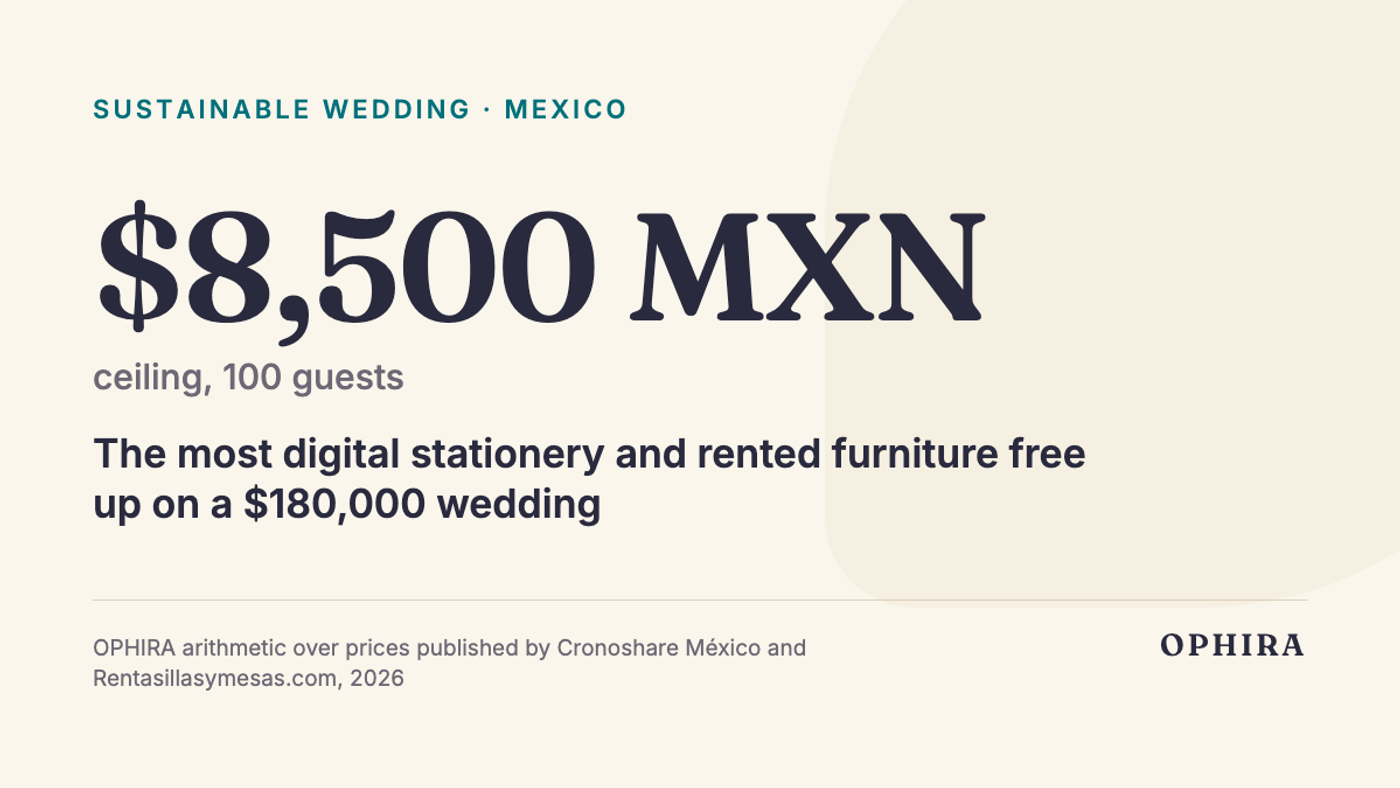
Add the ceiling of the two changes the market sells as sustainable and that you can control: digital stationery ($5,000 MXN) plus rented furniture ($3,500 MXN) equals $8,500 MXN. That's 4.7% of a $180,000 MXN wedding.
Welcome, but it doesn't change the conversation.
The cost that stings: the heavy line isn't decided with a word
Cronoshare calculates that venue, catering and drinks run between $75,000 MXN and $100,000 MXN for 100 people. Against a total of $180,000 MXN, that single line is between 42% and 56% of your wedding.
That's the needle. And it doesn't move with an adjective: it moves with scope.
That same line comes out between $750 MXN and $1,000 MXN per guest ($75,000 MXN and $100,000 MXN ÷ 100). Taking ten names off the list frees up between $7,500 MXN and $10,000 MXN: more than the $8,500 MXN of both eco decisions combined.
A single venue for ceremony and reception avoids, among other things, the $8,000 MXN of decorating a church you'll use for forty minutes.
Here's the constraint you'd rather not read: the only lever with real weight in a sustainable wedding is the guest list, and that one isn't paid with money. It's paid with uncomfortable conversations — with aunts, with your father's business partners.
Anyone promising you the same effect by changing the paper of the invitations is selling you peace of mind, not savings.
Eco wedding ideas in Mexico: the ones that move the number and the ones that move the photo
Both lists are useful. Just don't confuse them.
They move the number (they live in the heavy line):
- A single venue for ceremony and reception.
- The menu calculated on real confirmations, not on invitations sent.
- A guest list decided by criteria, not by inertia.
- Seasonal flowers as the starting point of the conversation with your florist, not as a concession at the end.
They move the photo and the conscience (and it's perfectly good that they exist):
- Digital invitation with online RSVP.
- Rented, already-reusable furniture and structures.
- Arrangements without floral foam, in vessels that come back to your team.
- Favors that are edible or alive, instead of objects.
When this trend isn't for you, and when to ignore it
It doesn't apply the same to everyone:
- If your venue is already closed with furniture and decor included in the package, the rental saving isn't yours: it's already inside and you won't capture it.
- If your wedding is under 80 people, your floral line lives in another range and the whole proportion changes.
- If your family covers the catering, the big lever isn't in your hands. There the small changes really are yours: make them gladly, and don't measure them in pesos.
And if sustainability is a commitment for you rather than a budget tactic, this calculation is beside the point. Do it because you want to. It stands on its own.
It's worth ignoring the trend entirely when it arrives disguised as a discount.
If a proposal uses the word "sustainable" to justify a higher price without telling you what changed, or to distract you from the venue and catering conversation, ignore it until the itemisation exists.
The message you can send your florist today
One action, and it's for today. Copy this and send it over WhatsApp to every floral proposal on your table:
Hi [name]. Before I compare proposals, could you send me the quote itemized piece by piece — bouquet, boutonnieres, centerpieces, altar and reception decor — with the price of each one separately? And please mark which ones are in season in the month of my wedding. I want to compare two budgets that today aren't comparable.
When both replies come back itemized, you'll see in thirty seconds something no published figure can give you: which of the two was quoting your wedding and which was quoting a different one.
And for everything else, the order that holds this up: in OPHIRA you can log each budget line with its amount, and every system category tells you the share of the total the Mexican market suggests for it — so a line that has grown out of proportion says so before you sign anything.
Start with venue, catering and drinks. Once that line has a number, sustainable decisions stop being an argument and become what they should always have been: preferences you can afford.